Walking Focus Group on youth perspectives in the eco-social transformation of the city
| 07/02/2022 |
| Elina Kränzle |
| Social Design Studio |
| Vienna |
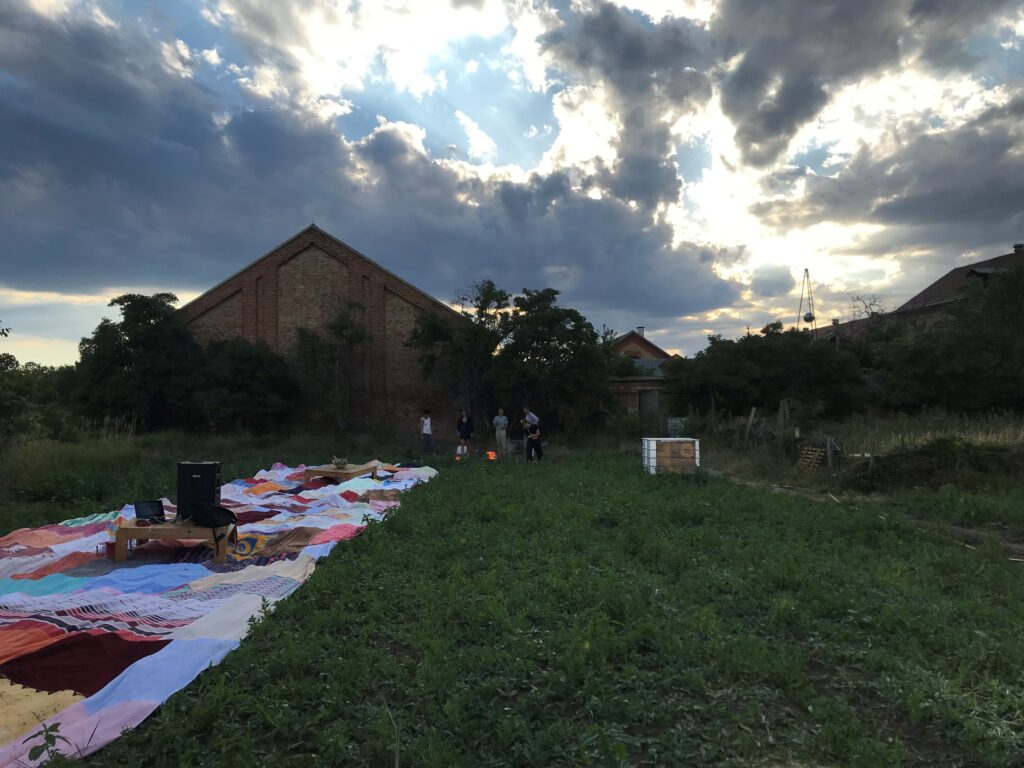
Today still fields and meadows as far as the horizon, soon a densely built-up part of Vienna. In just 25 years from now, Rothneusiedl on the outskirts of Vienna will provide housing for a growing city. How can these two opposing images be thought together? The eco-social transformation is already being tested at the hub of Zukunftshof. But what opportunities are given to young people? What role do they play in the design of green infrastructure and public space? As a “Walking Focus Group” we explored Zukunftshof as a possible open space for young people to participate in urban space production and discussed with actors from youth work, science, and administration, who gave an insight into their perspectives and experiences.
During the Urbanize! Festival 2022, the Viennese project partners from Social Design, treecycle and Forschen, Planen, Bauen of the TRUSTMAKING research project invited to a joint exploration of the Zukunftshof with a special focus: youth perspectives in the eco-social transformation of the city. Because in order not to forego the future, the cooperation with young people, and their perspectives and skills in urban transformation processes are essential. Where a change from urban consumers to urban producers and food production in the city of Vienna with a focus on social projects and educational programs can already be experienced today, one of four urban living labs of the TRUSTMAKING project will be kicked-off in 2023.
As a further development of the Walking Interview or “go-along” method (see e.g. Kusenbach 2003), we explored and discussed the farm and its surroundings as a “Walking Focus Group”. In the qualitative research method of the Walking Interview, researchers walk together around specific locations and engage in conversation with the participant, exploring the connections between self and location. The interview is usually recorded, mapped, and photo-documented to be evaluated later. As a Walking Focus Group we set a moderated group discussion in motion in order to incorporate the impressions of the environment into the joint reflection on places where young people could participate. We also recorded the discussions and documented the walk with the camera. Initiating the conversations with short talks, Magdalena Augustin (alleys made of sugar/ urban culture and public space, Vienna University of Technology), Irene Bittner (kampolerta – collective for landscape architecture, art and urbanism), Andreas Gugumuck (association and cooperative Zukunftshof), Korinna Lindinger (cultural sciences, University of Applied Arts Vienna ), and Isabella Steger (Werkstadt Junges Wien, Stadt Wien and WIENXTRA) discussed with the TRUSTMAKING team and around 20 other citizens and festival visitors at various stops along the way.
Farmyard – Impulse by Andreas Gugumuck
Andreas Gugumuck gave an overview of the interim use concept of eco-social urban agriculture, within the framework of which the association and the cooperative have been revitalizing Zukunftshof since 2019. From snail and mushroom farmers to sustainable street furniture and agricultural projects, various local actors show how cities and agriculture can be thought of together. The social project WUK.workspace supports young people in the transition from school to work. The young people, in turn, make a major contribution to the repair and renewal of Zukunftshof. In the TRUSTMAKING project, we want to explore how these young people can also be given space to help shape the upcoming development of the area and the role of Zukunftshof as a cultural center.
Kosmos Kuriosum Pavilion – Impulse by Magdalena Augustin
In front of the pavilion of the techno collective Kosmos Kuriosum, which has been organizing techno parties at Zukunftshof since 2020, urban researcher, cultural activist and DJ Magdalena Augustin discussed the spaces appropriated by music collectives and club culture as important experimental sites for young adults. Above all, such a place of opportunity needs a lot of freedom: the freedom to be loud, to be able to get involved in all work processes when building and designing, to work in informal structures with flat hierarchies. At Zukunftshof this freedom exists and thus the potential of a place “built around music” – as a social space, a place of appropriation, a center for community, self-organized and co-created.
treecycle nursery – impulse from Theresa Schütz, Johannes Wiener and Gregor Kiask
Theresa, Johannes und Gregor guided the group through the project’s own tree nursery and explained the ecological cultivation of the areas, the flowering plants and growing variety of insects in the garden, and the value of the nutrient-rich soil around Zukunftshof. All these aspects of organic farming represent an important part of the teaching in the Ausbildungsfit Jobfabrik educational project, in which treecycle works with a group of young people at Zukunftshof. Making a valuable, visible, and tangible contribution hands-on in the tree nursery and in the construction and planting of street furniture at Zukunftshof and beyond creates trust between the young people and the team, and finally creates trust of young people in themselves. Experiencing TRUSTMAKING as part of a work situation is a core value of treecycle’s work.
Garden – Impulse by Korinna Lindinger
Korinna Lindinger, sociologist and artist researching the child’s right to the city, continued with a discussion of the terms youth and young people – who is meant by youth, which young people? Which terms can we use without generalizing the very different realities of children and young people? With regard to the growing child and youth poverty in Austria and the unequal access to and representation of certain groups in eco-social and youth movements, she advocated sensitive participation formats.
Urban furniture in the courtyard – Impulse by Isabella Steger
Back in the large courtyard, the participants found space on the street furniture from treecycle, where Isabella Steger presented the Werkstadt Junges Wien project. In 2020, for the first time in Vienna, the project collected opinions, ideas and wishes from children and young people to improve and “repair” the city via a game set that was sent to schools and various organizations working with children and young people. Here, too, the participation of children and young people from different educational and social backgrounds was discussed – which institutions accepted and implemented the game? Who can participate in an online voting and who might be excluded from it?
Fields and barn – Irene Bittner
At the end of the Walking Focus Group, we explored the fields around the Zukunftshof. Looking at a large aerial photo of the area, we were able to get an idea of the dimensions of the planned urban development. With the future of Rothneusiedl as a densely built-up district in mind, the last impulse talk gave an insight into the appropriation of public spaces by young people in the densely built-up 20th district of Vienna. The landscape architect Irene Bittner presented her study (2015) and explained the different movement in and appropriation of open spaces by young women and men. There, social backgrounds also play an important role, Especially children and young people who grow up in cramped living conditions or in poverty need the freedom of public space – it replaces spaces for education as well as for leisure time.
Collective Mapping
In a joint mapping, the participants shared their perspectives, wishes and ideas for urban development that takes young people, their wishes and needs into account. What can we learn from the existing city? How can we keep free spaces and so-called wastelands open to children and young people as spaces of opportunity for subcultural appropriation? How can we enable trust-making processes? In order not to obstruct Rothneusiedl’s future, but to think about the needs and wishes of young people, we should retain voids today for what may only turn out to be relevant tomorrow.
Kusenbach, M. (2003). Street phenomenology: the go-along as ethnographic research tool. Ethnography, 4, 455e485.