Climate Gardening with Terra Preta
| 10/01/2023 |
| Sebastian Hafner |
| forschen planen bauen |
| Vienna |
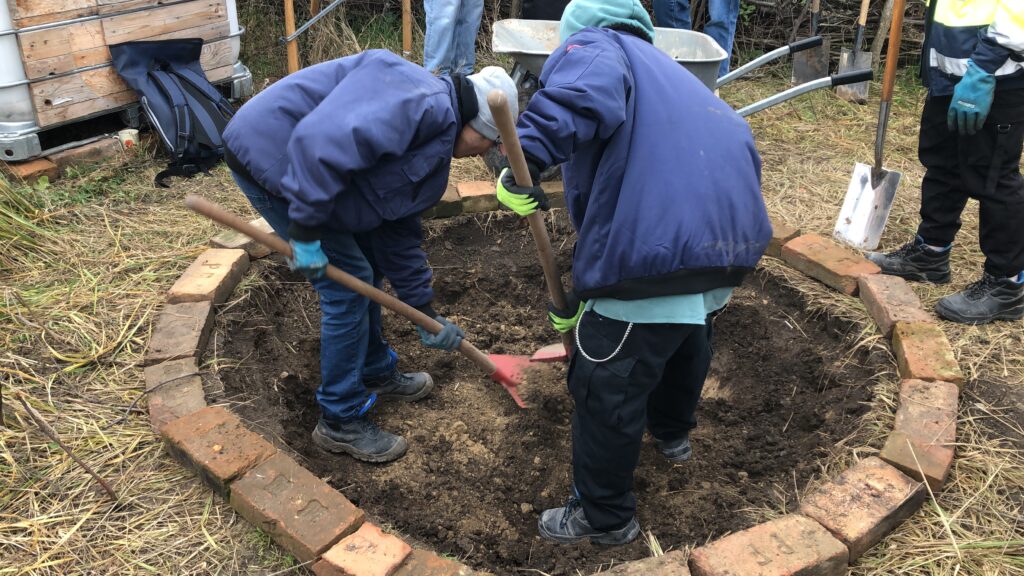
As part of the JPI Urban Europe project “TRUSTMAKING”, young people provide forward-looking impulses for urban development in the south of Vienna by applying an old cultural technique. Local material and immaterial resources play a role as well as the approach of climate gardening, which not only yields good harvests, but also binds greenhouse gases such as carbon.
„Terra Preta“ is Portuguese and refers to a deep black and fertile soil. Such soil is found in large quantities in the Amazon region of South America, even though the soil there is considered nutrient-poor. For years, they believed that forests could grow in the Amazon, but that agriculture was not possible.
The solution to this problem: The indigenous people of the Amazon produced Terra Preta themselves to increase soil fertility and to provide themselves with food. How did they do it? They knew how to use resources intelligently so that nothing was wasted. Charcoal and plant carbon played an important role in this.
Between fruit-bearing trees they laid out their fields and forest gardens. The combination of forestry and agriculture is still a common farming system among indigenous people today and was also common in our latitudes. Waste-wood and plant residues were used to make charcoal. During the industrialization of agriculture, this production system disappeared. A pile of charcoal mixed with daily waste materials, e.g. from the kitchen, could possibly have been the “recipe” for the accidental formation of a “Terra Preta substrate”. The quality of the otherwise nutrient-poor jungle soil could thus be significantly improved by building up organic matter or humus and binding nutrients.
With Terra Preta soils, the indigenous people of the Amazon achieved secure harvests, which eventually led to the rise of cities and entire cultures. But what does this ancient cultural technique mean for us today? How can it help us address the climate crisis and help make our cities future-proof?
A Burning Ring of plant residuals.
The key to this is the charcoal. This is created by charring tree- and green-cuttings. Some of the plant residues are therefore not metabolized into CO2 during decomposition, but become stable, non-degradable, porous charcoal and can be added to the soil. Carbon is thus sequestered, made available to plants, and thus leads to exceptionally good harvests while simultaneously reducing climate-warming greenhouse gases. A win-win situation.
At the Zukunftshof in Rothneusiedl, treecycle – urban eco-solutions together with forschen planen bauen – Thomas Romm ZT set themselves the task of using this old cultural technique for new areas of application in the city in the context of climate change. Understanding the city as an ecosystem means thinking in cycles. This is essential in the production of Terra Preta substrates.
The Circular City as a Climate Garden
The development area “Kurbadstraße” is located in the very neighborhood to Zukunftshof Rothneusiedl. Here, the construction of 750 apartments is planned. This makes cutting the trees currently standing on the site unavoidable. But it is precisely this green waste that can become a climate protection agent and nutrient store when turned into charcoal for Terra Preta. Let’s imagine that the raised beds on the roofs of the future apartments in Kurbadstraße will be filled with Terra Preta, making an important contribution to climate neutrality, and incidentally supplying the new district with local vegetables all year round.
We accept the challenge and first take up the spades. In Rothneusiedl, we are exploring the potential of Terra Preta substrate together with young people as part of an Urban Living Lab. Charcoal is relatively easy to produce. For example, biomass from tree cuttings or plant residues can be piled up in small, cone-shaped holes in the ground – so-called Kon Tikis – set alight , charred while depriving oxygen and extinguished. This process is called pyrolysis. Learning together by doing is not just about experimenting, but in particular about strengthening confidence in one’s own self-efficacy in solving the climate crisis.
The beneficial properties of vegetable carbon
One kilogram of plant carbon absorbs a multiple of CO2 (see Lehmann et al. 2006). Instead of being released into the atmosphere, the carbon is stored in the soil and cannot contribute to global climate heating. Therefore, increasing carbon content through Terra Preta on all agricultural soils is listed by the Intergovernmental Panel on Climate Change (IPCC) as one of the technologies to remove CO₂ from the atmosphere (see BMLFRW 2022). Some sources even project that the application of Terra Preta to all agricultural soils worldwide could reduce atmospheric CO2 concentrations to pre-industrial levels. While these assumptions are only theoretical and perhaps overly euphoric, they demonstrate the massive potential of this cultural technique in addressing the climate crisis.
Terra Preta substrates can also be used to increase humus content in the soil: The potential when using Terra Preta is up to 15% humus content in the soil (see Scheub et al. 2013) – conventionally farmed arable land in Austria has an average humus content of 2.5 – 4% (see Dersch et al. 2013). Food sovereignty or alternative energy supply when using pyrolysis waste heat are only two of the “side effects” of Terra Preta production.
Moving from small to large
We are standing on the field adjacent to the Zukunftshof on the outskirts of Vienna, the Terra Preta substrate in our hands, with a view of the wide field and the knowledge that a new urban district will be created here in the future. The young people are anticipating a piece of urban development here, mixing the black soil with the field soil and planting a fruit tree on the field edge. Young people are proving that even small steps can make a difference if you join forces with others. After all, something as banal as making black soil has real impact when it comes to the climate crisis. Moving from the small to the big. Nowhere is this connection more evident than in Rothneusiedl.
Sources
Dersch, G.; Spiegel, H.; Hösch, J.; Haslmayr, H.P.; Baumgarten, A.; Scheriau, S.; Hölzl, F. und Recheis-Kienesberger, J. (2013): Humusgehalt, Säuregrad und pflanzenverfügbare Phosphor- und Kaliumgehalte auf Acker- und Grünland in Oberösterreich. AGES – Österreichische Agentur für Gesundheit und Ernährungssicherheit, Wien.
Bundesministerium für Land- und Forstwirtschaft, Regionen und Wasserwirtschaft (2022): Humus in Diskussion. Bundesministerium für Land- und Forstwirtschaft, Regionen und Wasserwirtschaft, Wien.
Lehmann, J.; Gaunt, J; Rondon, M. (2006): Bio-Char Sequestration. In: Terrestrial Ecosystems – A Review. Mitigation and Adaptation Strategies for Global Change 11: 403–427.
Scheub, U.; Pieplow, H.; Schmidt, H.P. (2013): Terra Preta – Die schwarze Revolution aus dem Regenwald. Oekom Verlag, München.