| 09/08/2023 |
| Elina Kränzle & Sebastian Hafner |
| Social Design Studio/ forschen planen bauen |
| Wien |
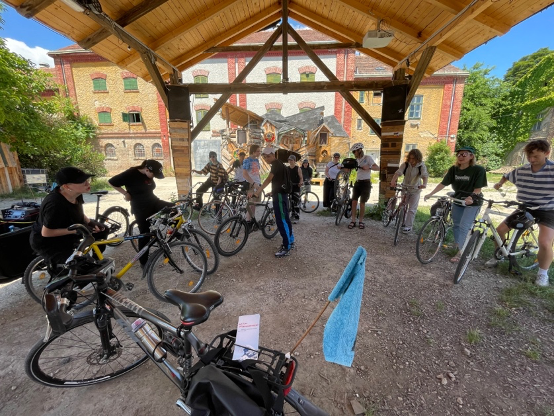
Where can we find the beach in the city? How does asphalt sound? And when was the last time you were in a field? With this load of questions, the TRUSTMAKING Living Lab Vienna, together with young people from WUK work.space, set off as a collective on bicycles from the city center to Zukunftshof on the edge of town. Along the route we got to know various initiatives, tracked down soil resources and discovered concrete beaches to open up new perspectives on a socially and climate-just future for the city during the Angewandte Festival.
1. Start at OKP
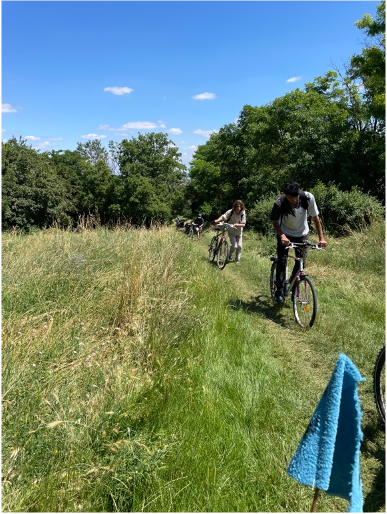
In the shadow of the temporary tree nursery on Oskar-Kokoschka-Platz, we had a last tire stop and sound check of our sound bike, and got equipped with flags and muesli bars before we set off as a colourful critical mass towards Kunst Haus Wien.
2. Pump Up the Heat!
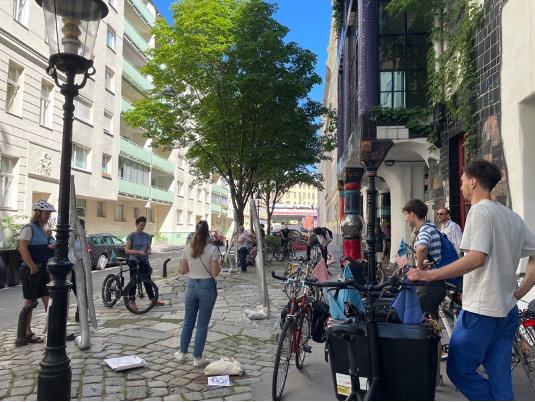
We’re heating up! Or cooling down? Through a hydrothermal renovation, Kunst Haus Wien, once designed by eco-pioneer Friedensreich Hundertwasser, is getting a sustainable air conditioning and ventilation system. By drilling beneath the Kunst Haus, the cooling and heating power of the groundwater is being harnessed for this purpose. Facilitator Jasmin Ofner and aquatic ecologist and artist Christina Gruber gave insights into the renovation of the building and the outdoor exhibition CLOSE/D, which opens surprising perspectives on global warming and planetary ecosystems in the neighborhood context.
3. Swimming allowed!
In the Sophiengarten, a public community garden, Schwimmverein Donaukanal (Swimming Club Donaukanal) has already opened the swimming season and is trying to revive the long history of public bathing culture there. Swimming, sunbathing or drifting with the current – Johannes told us how the association is committed to letting the former “Riviera of the working class” flourish again, on the many potential concrete beaches of the Danube Canal, in the middle of Vienna.
Our collective continued to cruise comfortably in the shade of trees along the Danube Canal before we entered the concrete jungle again: past the Town Town towers, via Würtzlerstraße and Baumgasse in the direction of St. Marx.
4. The concrete desert is alive!
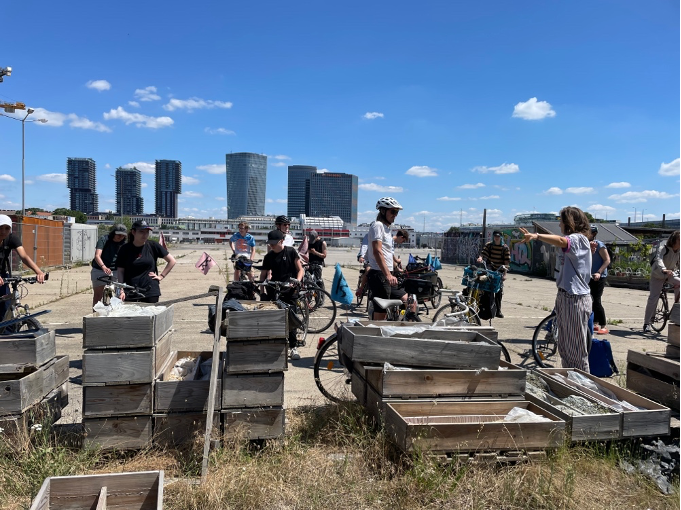
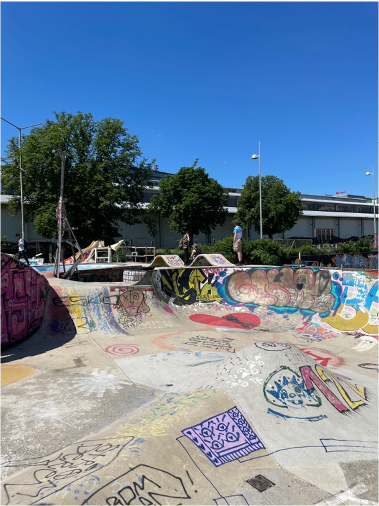
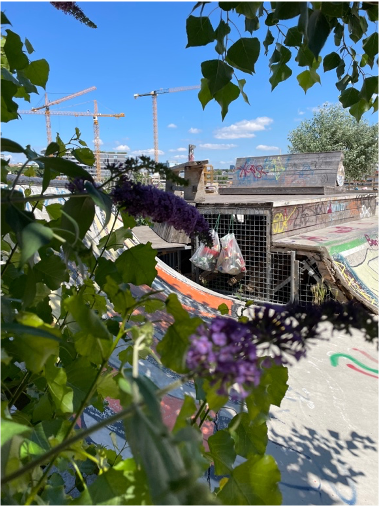
The Neu Marx für alle! initiative showed us that the concrete jungle is indeed a place full of life. Several self-organized, non-commercial community projects such as a skate park or the Neumarx Garden propagate that citizens can co-create public spaces, even if they are covered by a thick layer of concrete. After a breather in the concrete pool of the skate park and the sighting of drilling profiles, which allowed us to look deep under the sealed surface of Neu-Marx, busy streets and also a few meters of altitude lay ahead of us: via Simmeringer Hauptstraße, past Enkplatz, via side paths and railway tracks up to the Löwygrube.
5. Rich in natural resources
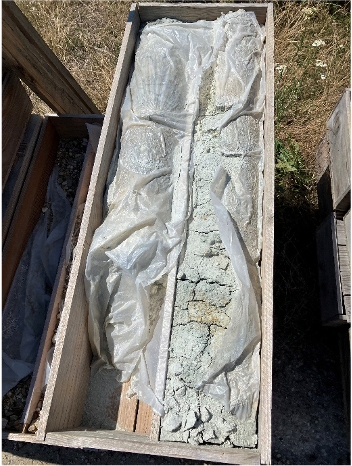
Löwygrube, today a popular local recreation area for the Viennese, still bears the traces of its history as a clay quarrying area for brick production in the Wilhelminian period. The transformation of an entire landscape in the south of Vienna is also a symbol of the industrial boom in the 19th century. The LaaerBergBauerinnen (Laaer Berg farmers) still cultivate the natural resources of the Löwygrube, but these ones are edible. Agricultural production, practiced in a communal, solidary and ecological way, makes the soil visible as a resource and pays respect to the place and its history.
6. Mud wraps and soil samples
Where today there are still gray traffic areas and parking lots of the Therme Oberlaa, a large-scale residential area is to be built in the next few years. In the residential quarter “Kurbadstraße – klimafit leben”, the soil and water conditions under the asphalt are currently being investigated. What is hidden under the concrete surface? – resources for the construction of the future city, a green park, or material for a mud wrap? At 30 degrees in the shade the collective decided against the mud wrap and for the straight way to the outskirts of the city.
7. To the Black Sea!
The Liesingbach led us not only to the last stop of our bike tour, but also (at least potentially) to the Black Sea. Via its mouth into the channel of the river Schwechat and finally into the Danube, it connects concrete beach and seashore. The 30km long stream has been regulated again and again in the course of history. For some years now, however, hydraulic engineering measures have been dismantled and the river renaturalized, creating habitats for animals and plants. Along the peaceful way of the stream we put the pedal to the medal one last time before the finish line.
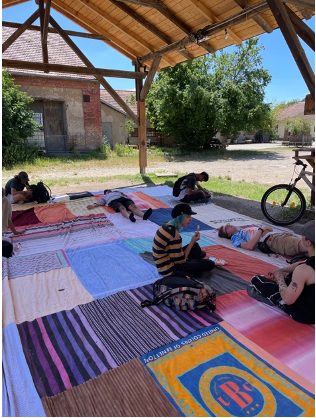
8. Field picnic in the future
We land in the green, and take a look into the future! Here, the concrete beach presents itself as a wide field and as one of the last places in Vienna where agricultural production takes place on a large scale. For the upcoming urban development of the area, the Zukunftshof is a living lab for creating circular urban food systems as well as for the co-design of green infrastructures by young people. The young people of WUK work.space have already been working here since 2021 under professional and socio-pedagogical guidance on various innovative projects at Zukunftshof. Now it’s time to stretch out our legs: After about 15km of persistent cycling we have arrived and end the tour with a picnic, sharing food, drinks and icecream as well as our impressions and thoughts. The conclusion: The way to a climate-just city leads across Vienna, to blooming brownfields and reclaimed open spaces and sometimes also against one-way streets, especially those in urban planning.